The 5 Best Types of Tools for Managing Social Media

Go! Blog Image Templates (900x350) (4)
4Jun

As we mentioned in a recent blog, social media marketing requires analysis just like any other marketing campaign. The solution for many businesses and brands is using a social media management tool. But what should you look for when choosing such a program? Here are a few crucial elements to consider.

1. Scheduling

Problem: Dana lives in Albuquerque, but her brand of portable speakers is most popular among affluent twenty-somethings in Japan. She’s noticed that her flash sales events have gotten a lot of traction with her domestic customers, but her overseas customers are not informed of the sale until it is almost expired. She can’t really afford to extend the sales, so just posting everything earlier wouldn’t help. Dana needs a way to schedule her posts so that they reach all of her potential customers in time.

Solution: A good social media management platform will enable you to schedule your posts for specific times. With such a tool, Dana can easily arrange for certain time zones to get the message before others. HootSuite and SproutSocial are two of the most popular scheduling apps available.

2. Measurement

Problem: Josie is a Baby Boomer who runs an online record store specializing in vintage blues albums and opera recordings. Thanks to some tech-savvy friends, she understands the basics of social media marketing. However, she still needs to know how her marketing campaign is affecting her sales. Josie needs a clear way to track and measure engagement, conversions, and other data.

Solution: Josie should look for an analytical tool that gathers all of the relevant data in one dashboard. These tracking tools are great for both social media marketing experts and novices! Google Analytics is a free app that covers multiple metrics.

3. Trends

Problem: Carlos runs a website that aggregates the latest in science news. He focuses mostly on climatology and environmental issues, but the eruption of Kilauea has sparked an interest in geology among his subscribers. His husband’s recent cancer scare prompted him to post more articles regarding epidemiology and cancer research. Carlos is worried that he just won’t be able keep up with the news he wants to cover. 

Solution: A news or trends aggregator application would help Carlos immensely. Not only would he be able keep track of multiple subjects, he would also be able to see trending topics. That would help him better tailor his material for each day. Carlos should look into Google Alerts (free) or Feedly (not free).

4. Management 

Problem: Tamika’s bookstore is flourishing, but her social media profiles have been somewhat neglected. She has accounts on Facebook, Pinterest, LinkedIn, Instagram, and Twitter–and she’s lucky if she can get around to even one of them every week! She needs a way to post to multiple social media networks simultaneously. 

Solution: Tamika is in luck: most social media management tools feature the ability to post to multiple networks at one time! While she would have to keep track of differences between platforms (e.g., not using Twitter handles on Facebook), this feature would allow her to optimize her limited time working on her digital marketing strategy. Buffer is a good possibility, as is HootSuite. (Note: HootSuite works with most platforms, but will not post to personal LinkedIn or Google+ pages.)

5. Engagement

Problem: Cecil’s podcast and blog on local politics exploded in popularity after he uncovered a major scandal involving the now-former mayor. He wants to engage with his audience, but he doesn’t know how he can now that it has grown so large. Cecil still works full-time, so he can’t just continuously monitor the site. And while he hasn’t had much trouble with trolls, he still deals with some negative feedback.

Solution: Until artificial intelligence becomes a bit more refined, Cecil’s best option is hiring a social media manager, or a social media firm. A social media professional will be able to monitor his accounts and respond to his audience. A good social media manager is skilled in public relations, too: he or she will be able to handle any online audience. If, however, all you need is an away message, you can set those up on most sites.

As long as you keep these elements in mind, you should have everything covered! From rookies to veterans, marketing professionals swear by these applications. Remember: when in doubt, ask an expert. 

Do you want to take your social media marketing to the next level? We can help! Contact us today for a free consultation!

Click Here to Subscribe

Read More

The Easy Way to Feature Videos on Your Facebook Page

Go! Blog Image Templates (900x350) (2)
28May

Posting your videos on Facebook is by no means a new idea. In fact it has been around nearly since the inception of the site years ago. What we want to focus on here is a Facebook enhancement that helps you present your videos in a more professional and engaging way to your audience.

This feature has benefits for both power and casual users alike. It’s imperative that you have at least one branded video on your social media channels. This video should be one that showcases your company and mission while bringing your brand to life.

Let’s get started going through these elements. Go to your Facebook Page and in the navigational tab directly underneath your cover image, you will see either the VIDEO tab or the MORE tab. If it is the VIDEO tab, click on it and meet us at the next step. If you see the MORE tab, click on it and choose VIDEO from the dropdown menu.

Now you will be on the Video screen. The first option that you have is to Create a Featured video. This is beneficial for those with many videos as well as those with just one. Choose the best video that represents your company (especially when viewed by new customers) and set this as your Featured Video. The Featured Video will now show up at the top of the Video page.

The second feature is more interesting to those power users who post tons of videos (or have more than 10 videos posted already): organize your videos into playlists to help people find what they’re interested in.

This is excellent as now your visitors won’t be blinded by an endless stream of videos while they try to make a decision as to what suits their interests best, they can go through the categories and dig into the ones that interest them with more immediacy. So those videos that you love, but are never viewed, will have a better opportunity to shine.

These video features on Facebook give you the opportunity to enhance your uploaded videos and provide a better way of showcasing your content. Whether you have 2 videos or 52, these features will help you organize and present your content in a more professional manner.

Start organizing! If you have any questions, we’re here to help!

Click Here to Subscribe

Read More

How to Perform a Social Media Audit

Go! Blog Image Templates (900x350)
23May

Our previous blog explained the importance of performing regular social media audits. Today we’re sharing the auditing process.

It’s just five simple steps. They won’t require any advanced software or programs (though certain types of tools can be helpful). You just need Google and a spreadsheet.

Take it step by step and discover for yourself how valuable the information you gain from a social media audit can be.

Phase 1: Create a Spreadsheet

You can do this with any spreadsheet program so let’s start by creating one using the program of your choice (Google Docs, Excel, Numbers, etc.).

Use one column for each social media platform, the next column for the URL to that account, and a column for the owner of each account.

Here, “owner” refers to the person in your organization who runs your social media, or at least that specific account. He or she is also the person who has access to the login information. If you have a department for social media, use either the head of that division or the individual employee who is responsible for each social media account. Likewise, if you use an outside social media marketing company, the “owner” would be your contact person or account manager.

Phase 2: Research

Search for your social presence on Google, using the name of your brand/company. If your company has any nicknames or shorthand versions (e.g., Chevrolet and Chevy, The Walt Disney Company and Disney), search for those as well.

Check each social media profile in the results. The objective of this phase is to gather data and discover any accounts you may have forgotten about or any accounts that someone else created (rogue accounts). Contact site administrators if you believe that someone set up a fake account in the name of your business.

Track the results with your spreadsheet, but only focus on the platform and URL for now. After you have listed every account, you will be ready to move on to the evaluation.

Phase 3: Evaluate the Platforms

Add a column labeled “Goals.” Knowing your goals for each platform will help you ascertain if your presence on that social media platform is beneficial to your brand.

Goals can include more reach, more engagement, etc. These goals can be as specific or as general as you prefer. Once you’ve established the goal for that platform, you can determine if a profile is working.

For example: The goal for your Instagram account is to increase brand awareness among retirees age 85 and over. Instagram, which skews towards a younger audience, is simply not the best platform for your brand.

After this phase, you should know which – if any – of your social media profiles you will delete.

Phase 4: Polish the Profiles

Make sure that each profile looks amazing. Check that all logos, icons, and other branding materials are current, and that the color scheme is also in-line with the brand. Update every bio and description. Ensure that all web addresses and contact information are correct.

After the cosmetic overhaul, you should take the audit further and look at each profile and answer the following questions:

  • Is the content aligned with the brand’s current marketing strategy?
  • Is the content consistent and on-message?
  • When was the last update?

This is also a good time to gather the login information for all of your social media profiles in one place so that you and your team can access any profile as needed.

Phase 5: Analyze Performance

Now, for the final step: analyzing the performance of each social media profile.

You need to determine how well each platform is working for you. What is the rate of engagement? How many clicks or comments did a given post receive?

You’ll also need to delve into your content: what type drives the most engagement? What is the quality of your engagement? We’ll discuss this step (and some of the tools you might use to simplify this process) in our next blog.

Getting the Most Value from Your Social Media Audit

You don’t have to rely on guess work or “gut feelings” when you make decisions about your social media marketing campaigns. If you follow these simple steps to do an effective audit of your social media activities, you can gain some important insights and make informed decisions about how you build your brand online.

Of course, there’s always more to learn, and at The Go! Agency we can provide a social media audit that gathers all the relevant data so we can provide actionable recommendations for optimizing your campaign.

Do you want to get more from your social media presence?  Contact us today to get started.

Read More

Level Up Your Marketing Strategy With a Social Media Audit

Go! Blog Image Templates (900x350)
21May

What is a social media audit?

Don’t let the word “audit” intimidate you. A social media audit is simply an analysis of your social media profiles undertaken to determine what parts of your social media marketing strategy are and are not working. You look at all of your social media accounts and profiles to figure out what strategies you should keep, what you should stop, and what you can improve. It’s not so much an audit as it is a check-in, really.

Why do I need one?

Here’s a better question: Does your company want to waste time, energy, and money on an ineffective marketing strategy? The answer is probably no. You need to periodically check your brand’s social media profiles to make sure each is still doing what you want it to do. This will also be a good time to find and delete any profiles you no longer use. Here a just a few of the many reasons you should audit your social media presence.

1. It’s an opportunity to clean up your online presence.

Think of your audit like cleaning out your garage: when you’re trying to reorganize and optimize the space you have, you find a lot of things you’d forgotten existed. Are you using all of your social media accounts? You might be surprised to discover that you have profiles on social media platforms you have not visited in years. Are you still paying for advertising on any platforms? You can delete profiles that are no longer beneficial to your social media marketing strategy.

2. You can check out your profiles.

A social media audit will allow you to look at the whole of your social media presence. You can see which profiles are up to date and which ones need to more current information. Use the audit to check out all of your social media profiles at once, so that you can edit and augment each as needed. Compare this to the piecemeal approach, where you vow to update your profiles when you remember, only to postpone the updates for when you actually have the time. With a scheduled social media audit, you can make the time.

3. You can revise your strategy. 

This is where the more technical aspects of auditing come into play. After you’ve weeded out the unnecessary profiles, you can make adjustments to the necessary profiles. Use each platform’s built in analytics tool to determine what content gets the most traction. You can also see data like busy times for your sites, customer demographics, and more. You can get as broad or as specific as you like.

4. This is a chance to gauge your competition.

You should take a look at your competitors’ social media pages as you audit your own. What are they doing that you are not? Does one competitor have more customer engagement than your brand? What type of posts are most popular for them? Are they following any industry-wide trends that you’ve ignored? Ignoring trends you’ve followed? Comparing your strategy to your competitions’ is yet another good way to learn what you’re doing right and what you’re doing wrong.

5. It’s a way for you to learn more about your customers.

As you gain insights into your competition (and thus your industry overall), you can also peek into the minds of your audience. Do they respond to one form of content more consistently than another? You could be wasting your time posting videos when your customers flock to blogs or vice versa. This is yet another benefit of looking at the big picture: you can see your marketing from a holistic point of view.

If you have even one social media profile (of course you do–you have no excuse not to be on social media), then you stand to benefit from a social media audit. Now that you understand why audits are so important, you should be eager to get started. We’ll discuss how to perform a social media audit for your company or brand in our next blog post.

Would you like to learn more about optimizing your social media marketing? We can help!

Click Here to Subscribe

Read More

Develop a Social Media Strategy in 7 Simple Steps

DEVELOP A SOCIAL MEDIA STRATEGY IN 7 SIMPLE STEPS
16May

You’ve finally convinced your company (or yourself) to establish a social media presence, so now what do you do? Here are a few steps you should take to develop a successful social media marketing strategy.

1. Research your audience.

When you first devised your marketing strategy, you probably created your ideal customer. By creating this image of your average consumer, you were then able to generalize the concept into your target audience. You’ll be doing the same here. Social media is all about connection. With whom are you trying to connect? Who is your target audience: working parents, college students, active retirees? Once you determine who you’re trying to reach, you will be be able to choose your platforms.

2. Research potential platforms.

Determine which platform(s) best suit your needs. Some social media platforms are geared for socializing (Facebook, LinkedIn), some for information (Twitter, Pinterest), and still others are designed for sharing your personal interests with the world (Tumblr, Instagram). Whatever your industry, there is a social media platform that will work for you. There are several questions you must answer to ensure that you choose the best platform. Which social media platform is your audience most likely to use? Why do most people use that specific social media site? What is the platform’s overall tone? 

3. Research your competition.

Investigate your competitors’ social media accounts. What are they doing that seems to work? Are certain posts garnering more engagement than others? Look at what their customers are sharing. Your goal in this endeavor is to learn, not duplicate. Let’s say that your business rival has an irreverent Twitter profile with thousands of followers. You should not attempt to cash in on their success by using a quirky voice for your own Twitter: it would look cliche at best, plagiaristic at worst. Consider instead appealing to the consumers who might be alienated by the humorous tweets by focusing on other aspects of your brand.

4. Establish your goal for each platform.

Each platform is different, so it stands to reason that your goals for each platform should be different as well. Some companies use Twitter as a way to attract new customers, and reserve their Facebook accounts for connecting with their existing clientele. Professional networking platform LinkedIn is great for companies with business to business sales, but maybe not as advantageous for a company that markets to retirees.

5. Determine your metrics.

You won’t know if you’ve succeeded unless you have a way to measure your progress. For social media, most marketing professionals use customer engagement as a starting point. How many likes are your posts getting? Are your customers sharing your stories or quotes? Whatever metrics you decide to use, you should choose them before you begin to produce content. 

6. Develop your content.

As mentioned above, you should focus on content development and production after you have established your metrics for success. This will prevent you and your staff from wasting time and energy working on the wrong types of content. What is your brand’s voice or tone: casual and fun, or earnest and professional? Deciding how you will say something will help you decide what you’ll be saying.

You should also formulate your company’s social media usage guidelines during this phase. These rules should function both as a style guide and code of conduct. Most companies simply abide by their in-house writing guidelines on their social media accounts. The other aspect addresses your company’s behavior on social media. Some good basic rules include steering clear of divisive issues and following basic netiquette. 

7. Engage with your audience.

The purpose of social media is to connect. When a customer reaches out to you, respond in a timely manner! Social media gives companies ample opportunities for stellar customer service. Don’t limit this engagement to problem solving, though: encourage audience engagement with contests, polls, and other fun methods.

As you can see, establishing your social media presence does not have to be a complicated process. The great thing about marketing is that you can shift your strategy as needed. The only irreparable mistake in social media marketing is avoiding social media altogether.

Do you still need help creating or refining your social media marketing strategy, why not seek out the experts? The Go! Agency team will devise or revise the perfect social media strategy for your brand! Click here to learn more today!

Click Here to Subscribe

Read More

5 Reasons Companies Still Don’t Use Social Media

5 REASONS COMPANIES STILL DON’T USE SOCIAL MEDIA
14May

To be perfectly blunt, there is no excuse for a company to have zero social media presence in 2018. According to the Pew Research Center, 69 percent of adults in the United States use at least one form of social media; 88 percent of adults age eighteen to twenty-four are active on one or more social media platforms. Most people have multiple accounts on different platforms.

Here are five common excuses for not using social media to promote your brand.

1. “Our target audience doesn’t use social media.”

Yes, they probably do. At least some of them do, anyway: the majority of American adults participate in one or more social media platforms. Social media has almost become our de facto national pastime. As with most new technology, the younger generations have been the most fervent adopters: almost 90 percent of young adults are active on at least one platform. These kids, teens, and (young) adults grew up with social media. However, their parents and grandparents are quickly adapting to the digital landscape and participating in social media. Pew states that 64 percent of people age 50 to 64 and 37 percent of people age 65 and older use at least one social media platform. 

2. “A social media profile will only attract negative attention.”

No, it will not. While it is true that some negativity is inevitable with any form of marketing, establishing a presence on social media offers more rewards than risks. The consumers of today actually want to connect with their favorite brands. Customers routinely seek out companies that make the products or services they love. You can minimize your risk of attracting negative attention in a few simple ways. First, devise a set of social media guidelines for your company. Second, enforce those guidelines with an iron fist (the modern equivalent would probably be a sternly worded email from HR). Additionally, consult with an expert. A good social media manager will be adept at public relations in addition to being a wunderkind with marketing and data analysis. 

3. “It doesn’t get results.”

Yes, it does. Granted, those results can be difficult to quantify, but they can still impact the brand. A presence on social media is at the very least an additional chance for your brand to be seen. Social media accounts offer your customers another avenue to contact your company with questions, concerns, or comments. This will go a long way toward engendering good will and repeat clients. Social media also keeps your customers better informed about your latest products or services–remember, customers need to know what you have to offer. Your social media presence can enhance your brand. A cosmetics company, for example, could post makeup tutorials on its Facebook page, while a sportswear manufacturer might include photos from its staff’s annual camping trip to its Instagram account. Social media strengthens your brand’s image in the minds of your customers. 

4. “It’s too much work.”

That depends. As with any marketing strategy, you get what you give when it comes to social media. You’ve worked for years to bring your company this far, why refuse to take this step? If you genuinely do not have the time to run your company’s social media activities on your own, have an employee to do it for you. We don’t mean that you should reassign an HR director to focus solely on your Facebook account: as with any other extra responsibility, you should find a person who possesses both the will and the skill to do the job. 

5. “I don’t understand how to use social media for marketing.”

This is perhaps the most common–and seldom revealed–reason that companies choose to avoid social media. Thankfully, it is also the easiest to address. If you are unsure how to navigate social media marketing, simply hire a consultant. There are many firms that focus exclusively on social media marketing. These experts want to help you develop your strategy and analyze your results. For many small businesses, seeking out the services of a social media pro is best and most cost-effective choice.

Do any of those excuses sound familiar? If so, stop waiting and start planning! Now is the perfect time to begin. That’s the great thing about marketing: every day is another chance to turn it all around. Don’t let your preconceived notions and unfounded fears about social media hold you back any longer!

If you need help developing or revamping your social media marketing strategy, just ask!

Click Here to Subscribe

Read More

5 Engagement Tips For Small Businesses

Go! Blog Image Templates (900x350) (1)
2May

Running a small business can be a daunting task. When you add marketing to your other duties, it almost seems impossible, right? Whether you’re trying to create a business empire from scratch or just trying to maintain the day-to-day, being in charge of a company is not easy! 

There’s a good chance that if you’re running your own business, you’re probably trying to maintain your social media accounts on top of everything else. If this is the case, you might not have the time, energy, or resources to promote yourself in the right way. Who has time to bother with Facebook, Twitter, and Instagram? As tough as it can be to fit social media into a packed schedule, it’s essential for any business to grow. Social media marketing has the strength to bring even a small local shop increased online visibility. How do you start? Check out these steps: 

1. Invest in update management software. A busy business owner can’t be bothered with spending several hours crafting content, posting, sharing, and liking. You will need help! A variety of programs are available to help you master social media marketing. Whether it’s Hootsuite, Buffer, or Onlypult, the right software can make social media management easier. 

2. Engaging content. You need social media marketing, but you need GOOD social media marketing. The right content will attract customers to your page, but the wrong content will repel them.

Find out how you can get your customers to create engaging content for you here.

3. Moderate promotions. Small businesses can use Facebook, Twitter, Instagram and other platforms for many different reasons, but you want to make sure to promote specials, happy hours, sales, events, etc. That being said, don’t forget to add other content into the mix. Don’t make your social media marketing presence solely about sales!

4. Promote in real life. Make sure people know about your online presence when they visit your store. Whether you run a restaurant, retail shop, or another small business, have “Follow Us!” signs up and offer exclusives that can’t be found anywhere other than Facebook, Twitter, etc.

5. Advertising. The biggest disadvantage a small business has is, well, it’s small. Because of this, it might be a little harder to get the word out about your brand than say, Coca-Cola or Chevrolet. That’s why it’s important that your message stands above the rest by investing some money into Facebook and Twitter advertising. Advertising has become an absolute must for companies trying to increase brand awareness and online visibility. The results are quickly visible, but a thought-out strategy is necessary.

Today’s small businesses have a special edge with social media marketing. Facebook, Twitter, and Instagram can help strengthen your online presence, professional status, and customer relations. 

Are you stumped by social media marketing? Let us take care of it for you! Click here to get started!

Click Here to Subscribe

Read More

5 Ways To Find The Perfect Customer Online

5 WAYS TO FIND THE PERFECT CUSTOMER ONLINE
30Apr

Are you trying to promote your business through Facebook advertising? Do you want to increase brand awareness on a local or global scale? Do you want a VERY specific group of people to see your ad? Maybe you want anyone and everyone to see you? It’s all possible, but you need a pro’s help. 

When we work on Facebook advertising for our clients, we are fully aware that we’re in for a task. Each business is an entirely separate entity and as such, requires a unique approach. Why? Because Facebook gives us so many options and avenues to visibility that we have to carefully craft a strategy for every advertisement. 

What are the best ways to fully utilize Facebook strategies? How should YOUR business use them?  Below are five of the most effective options that you can take advantage of when trying to market your brand. 

1. Location. When we’re looking at these options, we have to ask ourselves “Who do we want to click this ad?” Obviously, the answer should correspond with who your target customer is. Does your brand appeal to customers in your hometown or all across the U.S.? 

For example, the law office of Payne & Price wants to reach out to more potential clients. However, they only handle cases in Atlanta. Obviously, there wouldn’t be any point for them to pay for a national reach. People in non-relevant areas would see the ad and move on, and they would do so fast. Narrowing your geographical reach is important, especially if you are trying to appeal to a particular area.

2. Age and Gender. We have bunched these two together because many times they go hand-in-hand. Age and gender are important options that need to be specified in any campaign. Whether you know it or not, your product’s appeal has an age range. Often, it will also appeal to male or female audiences as well.

Safe Haven Nursing, an in-home caregiving facility typically for seniors, is trying to raise their brand awareness on Facebook. Their target audience is not the elders themselves, but rather their adult children. They should target the ages of 40-55 in their specified area. Since studies show that the children who make decisions about their aging parents’ healthcare are often daughters, they may also want to choose a female audience. 

On the contrary, My Cali, an eager startup clothing line that is aimed at Millennials, will want to target those between 18-35 to match their desired clientele. They can also make separate ads that feature male and female apparel. 

3. Life Events. Are you a wedding planner? Baby clothes retailer? Marketer for a college? This one is for you. People celebrate milestones in their life on Facebook quite often and as a result, you can offer them targets to compliment this time.

The marketing team at Hampton Ridge, a beautiful event venue in the Pocono Mountains, is trying to reach out to engaged couples looking for places to spend their special day. With Facebook marketing, they can target couples in the area who have been engaged for 3 months and 6 months. They won’t bother with those who have been engaged for over 12 months because those couples are typically ready to walk down the aisle. With Facebook advertising, you can be that specific.

4. Income. To be frank, what is the sense of marketing to a crowd that can’t afford your product? Or, you may want to reach out to a more or less wealthy clientele. Either way, you have the ability to target those in a specific financial bracket or those with a particular household income. 

The folks at Everclean Housekeeping were tired of being rejected after giving quotes for their services. Instead of lowering their rates, they decided to use Facebook marketing to target those with incomes $100K or above. They quickly saw a different demographic start calling in, and business improved.

5. Interests and Values. When I say interests, I don’t necessarily mean you should target people who like to play basketball or go hiking (although you could do that). Facebook has the ability to look at the Pages people have liked as well as tap into their profile information so users see promotional content they are actually interested in. 

This goes beyond hobbies or passions. Perhaps your product appeals to a more conservative or liberal audience? Maybe you want to reach out to the Christian, Jewish, or Muslim communities in your area? Or maybe you just want to promote your products to those who support your local football team. Whether it’s a personal interest or something that your target market values, it’s possible to connect with people with that shared commonality. 

As you can imagine, of all of these strategies this one takes some finesse. I would suggest you take a step back and look at your “typical” customer. What do you imagine them doing or participating in when they aren’t in your business?

Banyan Tree Tutoring was trying to reach out to parents in the Chattanooga, TN area. When they began their advertising journey, they chose to add several elements from above. First, they wanted to reach those who were interested in the local schools, Facebook pages about parenting and home-owning, and local sports teams. Then, because they are considered a premium service, they chose a specific income. Next, they chose the age range of the typical parents with school children, 28-50. Finally, they decided to stick within 20 miles of the Chattanooga city limits. Through these efforts, Banyan Tree Tutoring and thousands of other businesses are drumming up more business in ways they didn’t expect.

Are you excited yet? You should be! But you need to face facts, Facebook advertising is intense. It takes time, effort, and strategy. However, once you have it down, you will have an advantage over the competition and reach an audience you wouldn’t have access to otherwise. 

Ready to start Facebook advertising for your business? Contact us today

Click Here to Subscribe

Read More

5 Big Brand Marketing Strategies That Broke the Internet

Go! Blog Image Templates (900x350) (50)
23Apr

Social media itself is an innovative and cutting-edge approach to customer service. With Facebook, Twitter, Instagram, and the other amazing social media platforms, you can build relationships and connect with customers like never before. But if you add an expert team behind your strategy, it’s a business owner’s dream.

The best part? You will be able to see very quickly if your strategy works or not. Some top brands, such as the ones we will discuss below, raised the bar in terms of social media customer engagement.

As social media marketers ourselves, our team at The Go! Agency loves these brands’ approach to social media:

1. Wendy’s. The fast food chain has become notorious for sending out hilarious Tweets, often times addressing their biggest competitor, McDonald’s. But what’s really impressive about Wendy’s online marketing is how their audience engages, and the brand follows up with their comments. Below is a great tweet that shows how Wendy’s made a customer’s day while maintaining tone and message. It may downplay one of their own rules, but as you can see my the number of retweets, comments, and likes, it was well worth it.

2. Netflix. Netflix will often create trending campaigns that are funny and relatable. These usually tend to align with trending titles that are on their streaming service like Stranger Things or a Disney title, but they have also been known to tap into subject matter that their audience really relates to. And they do it well. A great example is their Netflix cheating campaign, where they “raised awareness” of the epidemic of partners watching episodes of TV shows without their partner– a heinous offense. Not only did it hit home for a lot of their audience, it was just tongue-in-cheek enough for it to go viral for quite some time.

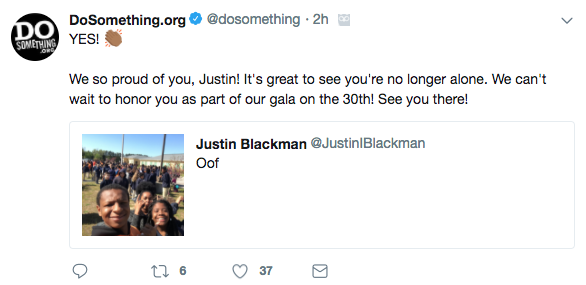
3. DoSomething.org. Clocking in with an astounding 811,000 Twitter followers, DoSomething.org has achieved something that not many businesses have been able to– create real conversations with the members of their audience. DoSomething.org helps activists stand up for causes they believe in. You can see in the snapshot below that they not only respond to the members of their growing community, they continue the conversation and encourage responses.

4. Apple. Apple is a little odd when it comes to social media. If you’ve ever visited their Twitter account they have never Tweeted– EVER. They will change their cover photo to the latest product imagery, but they never say a word . It’s a very odd strategy. But where they DO shine is on @AppleSupport, where they have a dedicated channel just for customer support. They respond ultra-fast and offer tips and tricks for all their devices. 

Apple Twitter

5. Funko. Funko is the maker of vinyl collectibles and pop culture memorabilia. 

If they didn’t utilize social media, however, they wouldn’t be able to reach the online success they have. There are two facets to their social media success– contests and Q&As. 

Multiple times a day, @OriginalFunko will post contests on their Facebook and Twitter. The prize is usually one or two of their collectible Pop! figures. The only thing people have to do to enter is follow the page and RT or comment. Then, they ask the contest winners to post a pic of their prize when they receive it in the mail, and the conversation continues.

Speaking of conversations, Funko shares weekly #AskFunko sessions, in which their huge fan base can tweet questions to them. Despite getting hit with thousands of questions, the Seattle-based team does their best to answer as many as possible for at least 30 minutes straight. 

These five brands are proud of their marketing strategies, and rightfully so. Each one has created communities that reach the thousands and their brand awareness is through the roof. Do yourself a favor and check out their Facebook and Twitter accounts and get ready to be inspired!

Did you know that our team at The Go! Agency, has years of experience in creating effective social media marketing strategies for our clients? 

Click here to learn more: http://ow.ly/z6PP30jBd5f

Click Here to Subscribe

Read More

4 Steps To Improve Twitter Customer Communication

Go! Blog Image Templates (900x350) (48)
18Apr

We all know about Twitter by now. Public figures and celebrities are always using this amazing platform to sound out messages, for better or for worse, to the masses. But millions of brands are using Twitter to reach out to their customers through social media marketing. The best way to do this? Offer innovative customer service solutions.

A major part of any social media marketing strategy is to employ a successful customer service strategy by using the platforms billions of people prefer. One of the most popular platforms for customer service has become Twitter. In fact over 58% of small businesses are on Twitter and use it for customer service.

Here are the best ways to use Twitter for better customer communication:

1. Offer open communication

Twitter is a great way to deliver top-notch customer service in a quick and convenient fashion. If someone sends a message or mentions your brand, you need to respond and quickly. Some businesses even have a specific Twitter account just for “support” communication, which is a great service to offer your customers because they’ll know exactly where to go when they have questions. We highly recommend this method, as it will also categorize customer service and content marketing tweets separately.

2. Response

If someone tweets at your brand, you better prepare a professional response and send it out quickly. It’s important to show that you care about your customers. The best part about this is that, when paired with a customer-support-exclusive Twitter account, the answers to common questions and concerns can be publicly displayed in your feed. Of course, many people will go the “private message” route. These messages should receive a professional, friendly, and fast response as well.

3. Start the conversation

Another important way to open up Twitter to better customer service is to open the floor to open communication. Let’s face it — Twitter is all about people talking. Turn your Twitter page into a social gathering by giving people a reason to begin a conversation. Ask your audience what their favorite product is, ask for feedback about a new service, or even offer a Q&A session. 

4. Go Live 

As predicted, live video continues to rock social media and Twitter is no exception. When it comes to customer service, there’s nothing better than instant answers, and live video gives your customers just that. By providing answers in real time, you’re not only helping the person who asked the question, but you could also be answering questions that other people have. We’ve used this method here at The Go! Agency and have started many rewarding conversations with customers this way.

Twitter is easy to learn, but it takes time to master. With over 320 million people flying around the platform, your ideal audience is already there, waiting for your awesome customer service stupport.

Get started on Twitter today by contacting us! Our team of social media experts is here to help your business soar. Click here to learn more:  http://ow.ly/PPeb30jtS06

Click Here to Subscribe

Read More
×