
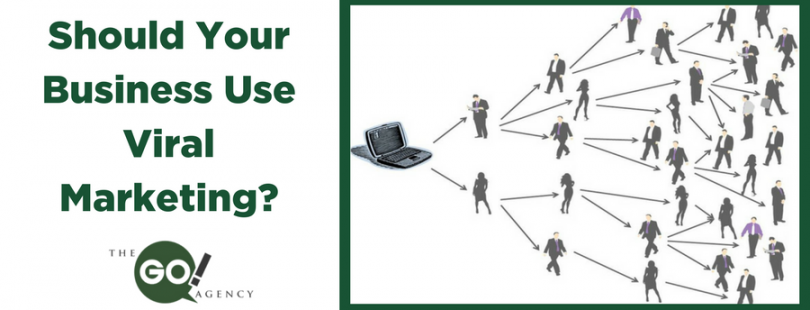
Should Your Business Use Viral Marketing?

2
2Aug

Going viral is the dream of many a business owner (and quite a few marketers too). It can almost instantly turn the fortunes of a company around and bring in hundreds of new customers overnight. Best of all, it’s all free. Other people do the marketing for you.

It sounds too good to be true, doesn’t it? In this post, I’m going to give you an introduction to viral marketing, how it’s done and whether it’s worth it.

What do you mean by going “viral?”

Something unique about online marketing is that your campaigns can grow organically past your original audience. Everybody has the ability to share anything they see on the internet with their family and friends. If you create engaging marketing, it’ll get shared. If it’s REALLY engaging, it’ll get shared again, and again, AND AGAIN!

When you go viral, your campaign (or content) starts to get shared so rapidly over a short period of time that hundreds of thousands of people end up seeing it. People love the content so much that they just can’t help themselves, they want everybody else to see it too!

The great thing about this is, if the content is to do with your business then literally hundreds of thousands of people will become aware of you.

Wait, so people will share my marketing for me for free?

Yes and no. One thing many people don’t realize is that a lot of so called “viral marketing” is just actual marketing. Many viral videos start off as paid advertisements that are targeted at an audience that will love them and want to share them.

Money is used to start the momentum for a lot of campaigns and that’s not to mention the money spent on creating the content itself. Whether it’s a silly video or an image, it’s going to cost to have it made.

So viral marketing seems like it’d be cheap, but really it’s anything but.

So what’s the best way to go viral?

Companies that truly go viral, don’t plan it, it just happens to them. Maybe they make a funny video, thinking nothing of it, then wake up a week later to find their inbox flooded with emails because somebody in Japan found their video hilarious and shared it with friends.

Actually attempting to go viral more often than not doesn’t work. Part of a lot of viral content is its authenticity. Trying to pander to an audience can often lead to an apathetic reaction or even worse backlash.

Like any other piece of content on the internet, your marketing will be open to comment, so if it’s not from a genuine place it’ll be torn apart immediately.

The best strategy to use for any marketing is to understand your audience and to be passionate about creating content that they enjoy and that entertains them. Think about what would make you click “Share,” then think about what would make your customers click “Share” too.

One example of marketing that often goes viral are Super Bowl ads, as their main purpose is to entertain rather than to drum up business. A good piece of viral marketing is 90% entertainment.

Having a plan in place for viral marketing is important

The biggest downside to a viral marketing campaign is that there are no guarantees. Since your campaign is depending on other people to share your content, that means a big part of its success is completely out of your control.

If your content doesn’t resonate at all, your whole campaign will have been a waste of money. So any viral campaign should be well thought out and executed. Like any other marketing campaign, you need to consider what will happen if you don’t succeed.

A viral campaign has a lot more risk to it than a regular campaign. If nobody is interested in the campaign, you’ve wasted your money as your main goal was to grow organic traffic. At least with a more traditional online marketing campaign, you will be more focused on other goals such as obtaining leads and converting them into sales, which leads to more revenue.

There’s a reason many viral campaigns come from large, international businesses. They have the money to waste!

But even if your viral campaign is a major success, it can be problematic. Many small businesses that have gone viral find that they get such an influx of new orders over such a small amount of time that their business can’t handle it.

To put it in perspective, imagine you made a video for your business that goes viral and almost immediately you find 10,000 emails in your inbox for new orders. Can you fulfill those orders in a timely manner? If not, then going viral might actually hurt your business.

So should you try to go viral?

Personally, I think there are more important areas to focus on for a business.

Trying to go viral is a lot like trying to become famous. You could spend years of your life trying and never get anywhere. Or you could be more realistic and focus elsewhere.

Instead of trying to go viral, it’s best to create marketing campaigns that resonate with your customers and content that is shareable. The better your online content is, the more people will want to read it and the more likely they’ll be to show it to their friends.

Your business doesn’t have to go viral to achieve success. Even a few shares from your loyal customers can create enough positive word-of-mouth to bring in new business.

Read More
The 20 Most Important Social Media Marketing Terms

The-20-Most-Important-Social-Media-Marketing-Terms-2-200x300
9Oct

Like every industry, social media has exclusive terms. Unlike every industry, however, those not in involved should know them as well. That’s one of the things that makes social media different – it’s for everyone. For you to promote your business the right way on Facebook, Twitter, LinkedIn, or other platforms, you should know the following terms. Get ready to spice up your vocabulary!

Avatar – Also known as a profile picture, avatars are the main images that represent you. Make sure it’s a good one and consistent from profile to profile.

Bio – A short, but detailed description about yourself or your company. No social media profile is complete without one!

Blog – Short for “web log”, a blog is where a company posts longer articles centered around their industry (like this). These are vital to any business’s website to look professional and knowledgeable about the field they work in.

Clickbait – A slang term for an eye-catching, but possibly misleading title. For example, “You won’t believe how this man lost 50 pounds!”

Direct Message – A private message to or from a Twitter profile. The Twitter equivalent of an email. Every platform has their version of direct messaging. Facebook’s is simply called Messages and has its own smartphone app.

Engagement – This is the ultimate goal of social media. Engagement is people interacting with your brand and its content. Comments, shares, likes, etc.

Facebook Live – Facebook’s live video streaming service. It’s already integrated into the website and app.

GIF – A looping animated picture that is typically soundless. You will find these on Facebook, Twitter, Instagram, and Tumblr the most.

Handle – @TheGoAgency is our company’s handle. It’s our username, but also how you can tag someone in a post on several platforms. A handle isn’t complete without the “@.”

Impression – A unit of measurement for social media advertising that analyses an ads’ reflectivity.

LinkedIn Groups – Groups are communities on LinkedIn where like-minded professionals can connect and share their work.

Meme – A popular running joke on the internet using familiar visuals. You will often see these with captions that incorporate the pre-existing joke into someone’s own message.

Native content – Original content that you upload directly to the platform.

Periscope – Twitter’s live video broadcasting app.

Pins – Pinterest’s signature feature. It’s their version of updates. However, you can also “pin” content to relevant boards.

Retweets – Twitter’s sharing feature. You can share someone else’s post onto your Twitter feed.

Stories – Snapchat and Instagram both have this feature, which allows you to view the recent posts from your friends or followers.

Tag – A way to incorporate someone into a post. You can do this on a majority of platforms.

User-generated content – Content that your followers, fans, and friends can share that involves your brand. Whether the content is reviews, posts, check-ins, etc., it’s still all about your brand!

Viral – Viral, or “going viral” is a term which means a piece of content reached extremely high engagement.

As you can see, social media is a very different world. That’s why a dedicated social media marketing team is so valuable. We know the ins and outs of this industry and can make your business shine.

Click Here to Subscribe

Read More

What Social Media Marketers Can Learn From Pokemon Go

What-Social-Media-Managers-Can-Learn-From-Pokemon-Go-200x300
12Jul

Do you remember the hit game Pokemon from the 1990s? While there have been several versions since Nintendo’s original incarnation, it’s popularity returned in a big way recently by tapping into the smartphone world where Pokemon Go, a completely new game, is available for free.

Not even Nintendo itself expected its new video game to take over the world as quickly as it did. Less than 24 hours after its release, Pokemon Go’s servers began to crash due to overpopulation on their digital frontier. Apple’s App Store and the Google Play Store both proudly house the massively popular game and at the time of writing this article, there are well over a million players trying to “catch ‘em all”.

Yes, it’s obvious that video games are popular. Yet by tapping into the mobile app market for the very first time, Nintendo has proven itself to understand the current trends in their field. However, there’s much more at work here than an app. From a marketing standpoint, they just accomplished a beautiful act.

Without getting into too many details, Pokemon’s popularity hit American shores in 1995 when their first two games debuted on Game Boy, the premier mobile gaming platform at the time. Children ate it up like it was the end of the world. Merchandising exploded. A TV show, a card game, action figures, stuffed toys, candy, clothing, themed stores, and much more took the world by storm. It was a marketer’s dream. Now, those children are in their mid-twenties and early thirties and have put the Game Boy down in place of an iPhone or Android device. Nintendo adapted perfectly to their original audience. Best of all, they made a majority of game play for free.

So, as social media marketers, what can we learn from this rising phenomenon? For one thing, watch internet trends closely. No surprise #PokemonGo was one of the top hashtags for quite some time. Brands that were able to somehow pull Pokemon Go into their social media posts received a nice spike of engagement. All over Facebook, Twitter, Instagram, and Pinterest, there were tons of Pokemon-related posts. Keep in mind that all of this publicity is free. Nintendo hardly advertised this app at all!

Social media marketers should also take note on just how ingenious Nintendo was to tap into their original market. Surely, today’s children could probably borrow their parents’ phones and play, but the numbers are coming in and it’s not a surprise to anyone that the most downloads are from those same people who played the original version. Nostalgia, it is one heck of a marketing tool.

Pokemon Go would not have been as much of a success without social media and you can take advantage of the firepower of these platforms just as easily.

What are your thoughts on Pokemon Go’s quickly rising popularity? Comment below!

Click Here to Subscribe to Our Free Newsletter


Read More
×